
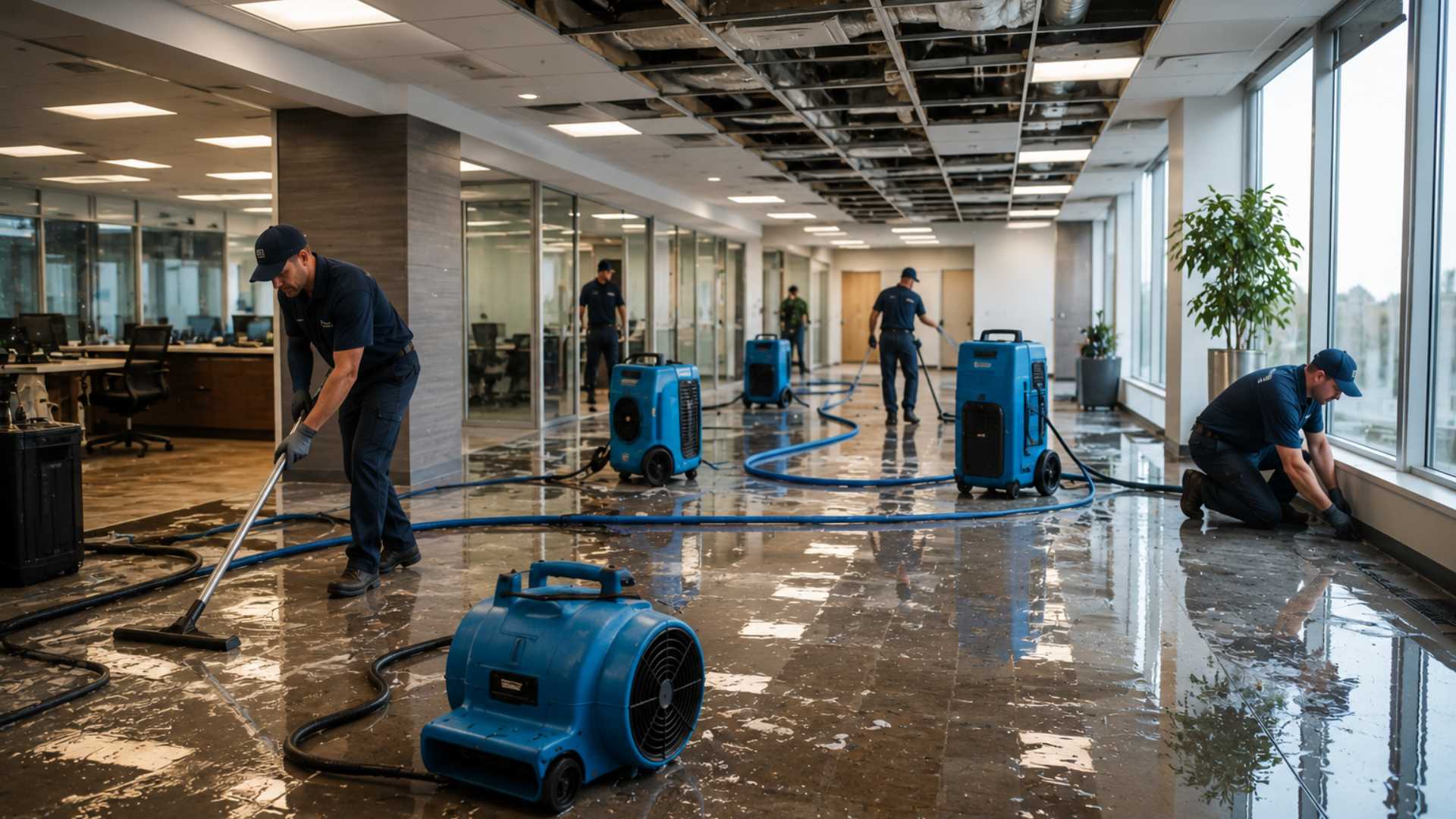
When disaster strikes a commercial property, the clock starts immediately. A burst pipe, a sudden fire, or a violent storm can shut down operations within hours, and the longer a building stays compromised, the harder it becomes to recover.
For business owners and property managers, the speed of the response often determines whether a setback becomes a temporary inconvenience or a costly, drawn out crisis. This is where fast commercial restoration becomes essential.
The financial impact of downtime is rarely limited to the repair bill. Every hour a facility sits closed means lost revenue, idle employees, frustrated customers, and tenants searching for answers. Staff may need to be relocated or sent home, deadlines slip, and the reputation you spent years building can take a hit in a single afternoon. Rapid response commercial restoration is designed to interrupt that downward spiral before it gains momentum.
Rebuilders Restoration was built around this exact challenge. With 24/7 emergency response, a Rapid Response Guarantee, and restoration teams focused specifically on commercial properties, Rebuilders Restoration helps businesses get Back to Business as quickly as possible across the Mid-Atlantic and Southeast.
Commercial restoration is the process of returning a damaged business property to the condition it was in before a loss occurred. It combines emergency stabilization, cleanup, drying, and rebuilding into one coordinated effort so that a facility can reopen safely and operate normally again.
Most commercial property losses stem from a handful of common causes, including:
A complete restoration response addresses both the immediate threat and the long term repair. Emergency mitigation stops the damage from spreading and stabilizes the property. Water extraction removes standing water before it soaks deeper into the structure.
Structural drying pulls hidden moisture out of building materials. Smoke cleanup neutralizes soot, residue, and odor after a fire. Reconstruction then rebuilds the affected areas, from drywall and flooring to mechanical systems, so the space is fully functional again.
The true cost of a disaster is measured in more than damaged materials. Downtime affects nearly every part of a business, and those effects compound the longer recovery takes.
A closed facility cannot generate income. Retail floors sit empty, production lines stop, and service appointments get canceled. For many businesses, even a few days offline represents revenue that can never be recovered, along with momentum that is difficult to rebuild.
When a workplace becomes unusable, employees lose access to the tools, equipment, and environment they rely on. Some may be relocated to temporary spaces, while others sit idle. Payroll continues even when productivity stalls, which quietly drains resources during an already stressful period.
Customers expect consistency, and tenants expect a safe, functional building. A prolonged closure tests both relationships. Tenants may demand rent adjustments or begin looking elsewhere, while customers shift their loyalty to competitors who remain open and reliable.
Damaged commercial buildings can quickly fall out of compliance with safety codes. Standing water, fire residue, and structural instability create hazards for anyone who enters. Operating in those conditions exposes a business to liability and puts occupants at risk, which is why a controlled, professional response matters.
Speed is the single most influential factor in a successful restoration. The faster mitigation begins, the more of the property and its contents can be saved.
Initial damage is only the beginning. Left unaddressed, water encourages mold growth that can spread through a building within a day or two. Prolonged moisture leads to structural deterioration as wood swells and weakens. Equipment exposed to water or humidity begins to corrode. Fast intervention stops these secondary problems before they take hold.
A small, contained loss is far less expensive to repair than one that has spread throughout a facility. Early mitigation limits the scope of the damage, which means fewer materials to replace and less reconstruction overall. Acting quickly is one of the most reliable ways to control total project costs.
Insurance claims move faster when damage is documented thoroughly and early. A prompt response allows the restoration team to capture accurate records of the loss before conditions change, which supports a smoother claim and a quicker path to payout and repair.
Not every restoration provider is equipped to handle the demands of a commercial loss. A few core capabilities separate a strong response from a slow one.
Disasters do not wait for business hours. A restoration partner needs to answer the call any time of day or night, every day of the year, so help is on the way the moment a problem is discovered.
Once a team arrives, a quick and accurate assessment sets the tone for the entire project. Identifying the source, the extent, and the safety risks immediately allows the right resources to be deployed without delay.
The first actions taken on site have the greatest impact. Extracting water, containing affected areas, and stabilizing the structure right away prevents the loss from growing while a full plan is put in place.
Business owners need to know what is happening and what comes next. Consistent, transparent communication keeps decision makers informed and allows them to plan around the recovery timeline with confidence.
Every business benefits from a quick recovery, but some face especially high stakes when their facilities go offline.
Hospitals, clinics, and care centers cannot pause operations. Patient safety and strict sanitation standards make rapid, thorough restoration absolutely critical, which is why Rebuilders Restoration offers a dedicated 60-Minute Emergency Response for medical facilities.
Schools and universities serve large populations daily. A closure disrupts learning, displaces students and staff, and creates scheduling challenges that ripple across an entire term.
Hotels and event venues depend on availability and guest experience. Damage to rooms or common areas directly affects bookings and revenue, making speed a priority.
Office environments house teams, technology, and sensitive records. Fast restoration keeps employees working and protects the systems that run the business.
Retail spaces and industrial plants rely on inventory, equipment, and continuous operation. Downtime in these settings can halt supply chains and erase sales that are tied directly to the calendar.
Rebuilders Restoration is structured to deliver speed where it counts. The Rapid Response Guarantee promises that an emergency team will arrive on site within 4 hours of your call, day or night, supported by around the clock availability so a team is ready whenever disaster strikes. Restoration crews are focused on commercial properties, which means they understand the scale, systems, and urgency that businesses require.
Beyond the cleanup itself, Rebuilders Restoration assists with insurance claims, helping document the loss and work alongside carriers to keep the process moving. Full service reconstruction capabilities allow the same team to handle everything from mitigation through final repairs, including roofing, mechanical systems, drywall, paint, and flooring. For significant losses, Rebuilders Restoration provides large loss response across its service regions throughout the Mid-Atlantic and Southeast, giving even major facilities a clear path back to normal.
After a disaster, every hour matters. The faster a business responds, the more it can save in property, revenue, and reputation. Delay invites secondary damage, higher costs, and longer closures, while a rapid, organized response keeps recovery on track.
The smartest approach is to plan ahead. Knowing who to call before disaster strikes, and choosing a partner with proven speed and commercial expertise, turns a potential catastrophe into a manageable event. When the unexpected happens, immediate action is the surest way to protect business continuity and get Back to Business™.
Restoration should begin as soon as the property is safe to enter, ideally within the first hours after the damage occurs. Mold can begin developing within 24 to 48 hours of water exposure, and fire residue grows more corrosive over time, so the sooner mitigation starts, the less damage spreads.
Yes. Delays allow secondary damage such as mold, structural weakening, and corrosion to develop, which raises repair costs and extends downtime. The longer a facility stays closed, the more revenue, productivity, and customer trust are lost.
Any commercial property can experience a loss, but healthcare facilities, schools, hotels, office buildings, retail stores, and industrial sites face especially high stakes because downtime directly disrupts the people and operations that depend on them.
Yes. Comprehensive commercial restoration covers the full process, from emergency mitigation and drying through reconstruction. That includes rebuilding structural elements, repairing mechanical systems, and finishing work such as drywall, flooring, and paint.
A qualified restoration partner documents the damage thoroughly and works alongside insurance carriers to support the claim. This helps streamline paperwork, reduce disputes, and keep the recovery moving forward without unnecessary delays.
When disaster strikes, every minute matters. Whether your commercial property has experienced water damage, fire, storm destruction, or another emergency, acting quickly can help reduce downtime, prevent further damage, and protect your investment.
Rebuilders Restoration is available 24 hours a day, 7 days a week, with experienced professionals ready to respond whenever you need immediate assistance. Call now for fast, reliable commercial restoration services and expert support throughout the recovery process.
Looking beyond the current emergency, the best way to minimize future risks is through preparation. Ask about our Pre-Disaster Plan, a proactive program designed to help businesses recover faster by providing priority emergency response, customized disaster planning, and a clear restoration strategy before an unexpected event occurs.
With a plan already in place, you can reduce disruption, protect your property, and get back to business with greater confidence when the unexpected happens.