
When water invades a commercial property, the terms used to describe the recovery can be confusing. Many property owners use water mitigation and water restoration interchangeably, assuming they describe the same service. In reality, they are two separate but closely connected phases of recovery, and understanding the difference helps owners make better decisions and set realistic expectations during a stressful event.
Mitigation and restoration work together, but they happen at different times and pursue different goals. Mitigation comes first and focuses on stopping the damage. Restoration follows and focuses on rebuilding what was affected. Knowing how each phase functions, and why both are necessary, gives business owners a clearer view of the road back to normal operations.
Mitigation is the emergency phase of water damage recovery. It is the rapid, protective response that happens before any rebuilding takes place.
Water mitigation refers to the immediate actions taken to limit and prevent further damage after water enters a property. Rather than repairing or rebuilding, mitigation is about containment and stabilization, stopping the situation from getting worse while the property is assessed.
The central purpose of mitigation is to halt the spread of water and the problems that follow it. Water moves quickly through a building, soaking into materials and creating conditions for mold and decay. Mitigation interrupts that process as fast as possible to preserve as much of the structure and contents as it can.
Mitigation includes a focused set of emergency services. Emergency water extraction removes standing water before it spreads. Moisture removal targets dampness that has soaked into surfaces. Structural drying pulls hidden water out of building materials, while dehumidification reduces humidity in the air to support that drying. Temporary stabilization, such as board up or containment, secures the property and isolates the affected areas until full repairs can begin.
Restoration is the rebuilding phase. Once the threat has been neutralized through mitigation, restoration brings the property back to working order.
Water restoration refers to the work of repairing and rebuilding the parts of a property that were damaged by water. It picks up where mitigation leaves off, transforming a dried, stabilized space into a fully functional one again.
The objective of restoration is to return the property to the condition it was in before the loss occurred. That means more than patching visible damage. It involves restoring the look, function, and safety of the space so the business can resume operations as if the event never happened.
Restoration covers the repairs that make a building whole again. This includes general repairs to damaged components, reconstruction of affected areas, and flooring replacement where materials cannot be saved. Drywall restoration rebuilds walls and ceilings, while painting and finishing complete the space and return it to a polished, professional appearance.
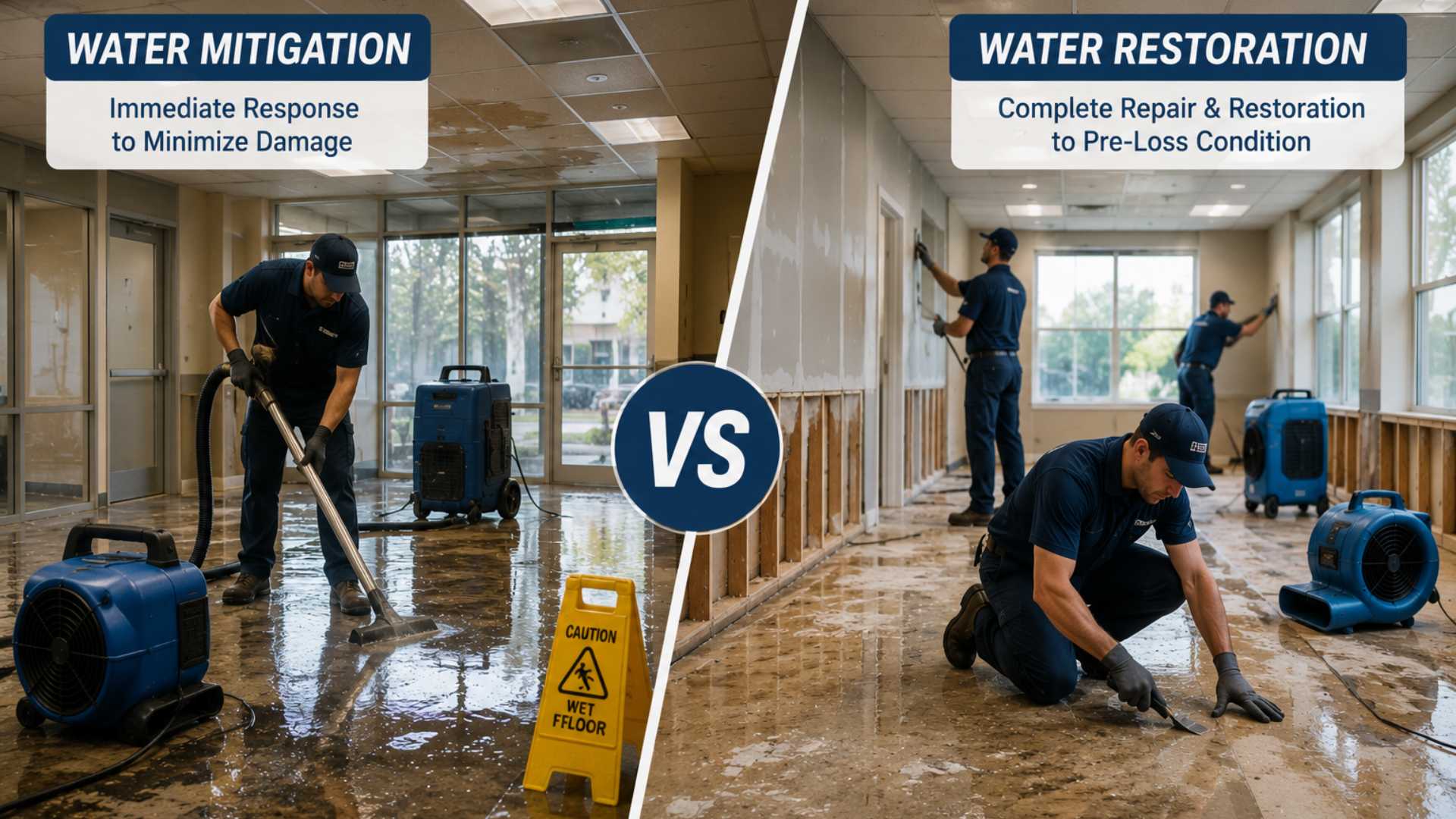
Seeing the two phases next to each other clarifies how they differ and why they belong together.
Mitigation happens first, in the emergency window immediately after water intrusion. Restoration follows once the property has been dried, stabilized, and assessed. One responds to the crisis, the other rebuilds from it.
Mitigation aims to prevent further damage and preserve what remains. Restoration aims to repair and rebuild, returning the property to its original condition. The first protects, the second restores.
Mitigation relies on extraction units, air movers, and dehumidifiers to remove water and moisture. Restoration relies on construction tools and materials such as drywall, flooring, paint, and finishing supplies to rebuild the space.
Mitigation is usually completed in a matter of days, since speed is essential to its purpose. Restoration often takes longer, ranging from days to weeks depending on the extent of the damage and the scope of the rebuild.
Restoration cannot succeed if mitigation is skipped or rushed. The two phases follow a deliberate order for important reasons.
Mold can begin developing within 24 to 48 hours of water exposure. Mitigation removes the moisture that feeds it before restoration begins, ensuring that new walls and floors are not built over a hidden mold problem.
Water weakens wood, drywall, and other building materials over time. By drying the structure thoroughly during mitigation, the recovery protects the underlying components so that restoration is built on a sound, stable foundation.
Effective mitigation limits how far the damage spreads, which directly reduces the amount of rebuilding required later. The more water and moisture removed early, the less material needs to be replaced, keeping the overall project more affordable.
For a commercial property, mitigation and restoration are part of one continuous recovery that unfolds in clear stages.
The process begins with a fast emergency response. A restoration team is dispatched to the property, often around the clock, to evaluate the situation and begin protecting the building right away.
Next comes mitigation, with water extraction, drying, dehumidification, and stabilization. This phase stops the damage from advancing and prepares the property for assessment and repair.
Once the property is stabilized, a detailed assessment determines the full extent of the damage and what restoration will require. This evaluation shapes the rebuilding plan and supports the insurance claim.
Finally, restoration rebuilds the affected areas, from repairs and drywall to flooring, painting, and finishing. This phase returns the property to its original condition and readies it for normal operations.
One of the advantages of working with a full service partner is that mitigation and restoration are handled by the same team, eliminating gaps and handoffs that slow recovery. Rebuilders Restoration delivers a rapid response so protective work begins quickly, then carries the project through every stage that follows.
That includes water extraction to remove standing water, moisture monitoring to track drying progress, and structural drying to pull hidden moisture out of the building. When the property is stable, Rebuilders Restoration provides full reconstruction services to rebuild and finish the space. Managing both phases under one roof keeps the timeline tight and helps businesses get Back to Business as quickly as possible across the Mid-Atlantic and Southeast.
Mitigation and restoration are not competing services or interchangeable terms. They are two essential stages of the same recovery. Mitigation stops the damage and preserves the property, while restoration rebuilds what was affected and returns the space to its original condition. Skipping or shortchanging either phase puts the entire recovery at risk.
For commercial property owners, the lesson is simple. When water damage strikes, both mitigation and restoration are necessary, and they work best when delivered quickly and in the right order. Partnering with a team that handles both ensures a smoother, faster, and more complete return to normal.
No. Mitigation is the emergency phase that stops further damage through extraction, drying, and stabilization. Restoration is the rebuilding phase that repairs and finishes the property. They are connected stages of one recovery, not the same service.
Generally no. Restoration should wait until mitigation has removed the water and dried the structure. Building over moisture risks hidden mold and structural problems, which is why mitigation comes first and restoration follows.
Mitigation is usually completed within a few days, since speed is critical to limiting damage. The exact timeline depends on the amount of water, the materials affected, and how quickly the response begins.
Structural drying removes moisture trapped inside walls, floors, and other materials where it is not visible. Without it, hidden dampness can cause mold growth and weaken the building over time, undermining any repairs made on top of it.
In most cases, yes. Mitigation protects the property and prevents the damage from spreading, while restoration rebuilds what was affected. Together they return the property to its original condition and allow the business to reopen safely.
Water intrusion can disrupt your business, damage valuable assets, and lead to costly repairs if not addressed immediately. Rebuilders Restoration provides rapid emergency response to minimize damage and begin the recovery process without delay. Our experienced team handles every stage of the project, from emergency water mitigation and moisture removal to complete water damage restoration, ensuring a seamless recovery from start to finish.
With all restoration services under one roof, you can count on clear communication, efficient project management, and quality workmanship every step of the way. Contact Rebuilders Restoration today for 24/7 emergency water damage services and let us help you restore your property and get your business back to normal as quickly as possible.